7 carbon brush manufacturer tips distributors should know
- Aarav Reddy
- Mar 23
- 5 min read

If you are a distributor managing supply chains for industrial equipment, motor components, or power transmission systems, you already know that sourcing decisions are rarely simple. One wrong supplier relationship can stall your entire operation — and few components carry that risk more quietly than carbon brushes.
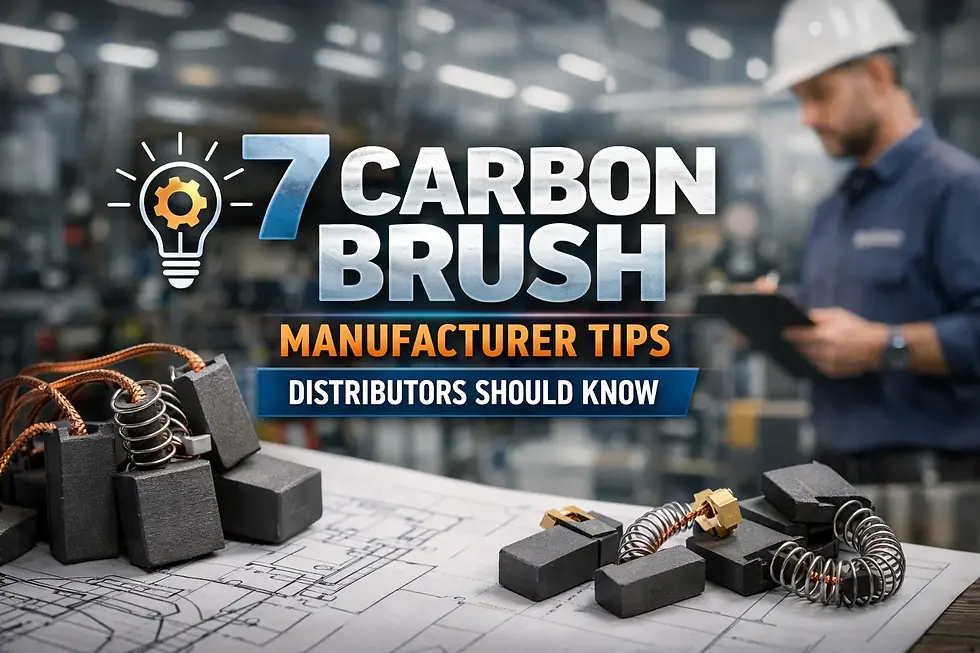
This article is for distributors who want to change that approach. Whether you are entering the industrial components space or renegotiating existing supplier contracts, working with the right carbon brush manufacturer requires a structured, experience-informed process — not guesswork.
Here are seven practical tips that experienced industrial distributors use when evaluating and managing carbon brush sourcing relationships.
1. Understand the Grade Before You Negotiate the Price
Carbon brushes are not a single product. They come in a range of material grades — electrographitic, metal graphite, resin-bonded, and natural graphite among them — each suited to specific operating conditions, current loads, and surface speeds.
Before you enter any pricing conversation, confirm that you understand what grade is required for the end application. A distributor who leads with price before confirming grade compatibility risks sourcing components that fail prematurely in the field — and absorbs both the replacement cost and the reputational damage.
Ask your manufacturer to share a grade selection guide or application matrix. If they cannot provide one, that itself is useful information about their technical depth.
2. Evaluate Technical Support as Part of the Supplier Offering
A carbon brush manufacturer worth distributing for does not simply ship boxes of components. They offer technical guidance on brush grade selection, holder design, and surface preparation — especially when you are supplying to end-users who may not have in-house electrical engineering expertise.
This matters most in the SME and mid-market industrial segment, where buyers rely heavily on distributors to translate technical requirements into correct component specifications.
When evaluating a new supplier, ask specifically: who on your team will support my customers when application questions arise? The answer reveals a great deal about whether a manufacturer thinks in terms of products or solutions.
3. Clarify Minimum Order Quantities Against Your Real Demand Patterns
MOQ structures vary considerably across manufacturers. Some set minimum order quantities by grade, others by total weight, others by SKU count. For distributors managing multiple product lines, misaligned MOQs can create serious inventory problems — either forcing overstock of slow-moving grades or leaving gaps in fast-moving ones.
Before finalising any supplier agreement, map your historical demand by grade and cross-reference it against the manufacturer's MOQ structure. Where there are gaps, negotiate flexibility — either through mixed-grade ordering options or staggered release schedules.
A manufacturer willing to work within your actual demand reality is demonstrating partnership thinking, not just transactional intent.
4. Inspect Quality Certification — and the Process Behind It
ISO certification is a starting point, not an endpoint. When a manufacturer presents quality credentials, go one level deeper. Ask to see their internal quality control process — specifically, how brushes are tested for dimensional accuracy, electrical resistivity, hardness, and surface finish before they leave the facility.
Understanding the Applications of Carbon Brushes across motors, traction systems, welding equipment, and industrial generators also helps you ask smarter questions. Each application category demands different tolerance levels and performance benchmarks. A manufacturer with deep application experience will be able to walk you through those distinctions clearly.
If quality documentation is vague or inconsistent, that is a red flag — regardless of how competitive the pricing appears.
5. Test Lead Time Reliability, Not Just the Quoted Timeline
Most manufacturers will quote a standard lead time during the sales conversation. Experienced distributors know that quoted lead time and actual lead time can diverge significantly, particularly during peak production periods or when raw material supply is under pressure.
Before committing to a long-term distribution agreement, run a controlled test. Place a trial order of moderate volume and measure actual delivery performance against the quoted timeline. Note how the manufacturer communicates during the production cycle — proactively or only when prompted.
Reliable lead time management is not just an operational convenience. For distributors supplying to manufacturing plants or maintenance teams operating on scheduled downtime windows, late deliveries have direct cost consequences for your customers.
6. Assess Supply Chain Transparency and Raw Material Sourcing
The quality of a carbon brush is shaped significantly by the quality of raw materials used in its production — graphite purity, metal content, and binding agents all influence performance under load and under heat.
Ask your manufacturer to share information about their raw material sourcing. Where does their graphite come from? How do they manage supplier consistency? Do they conduct incoming material inspection before production?
This level of transparency is not always easy to obtain, but it is worth pursuing. Distributors who understand their upstream supply chain are better positioned to anticipate quality shifts and manage customer expectations proactively.
It also signals to your end-customers that you are a technically informed partner — not simply a pass-through between factory and buyer.
7. Build Inventory Planning Into the Relationship From Day One
One of the most common failures in distributor-manufacturer relationships is the absence of joint inventory planning. Distributors often manage demand volatility on their own, absorbing the risk of stockouts or overstock without the manufacturer having visibility into what is actually happening at the market level.
A well-structured relationship with carbon brush suppliers should include periodic demand reviews, shared forecasting where possible, and agreed safety stock levels for your highest-velocity grades. This is not about giving a manufacturer access to your business intelligence — it is about creating a supply rhythm that reduces friction for both parties.
The manufacturers who engage in this kind of collaborative planning tend to deliver more consistent service over time. Those who resist it are often optimising for their own production convenience, not your distribution success.

Conclusion
Sourcing carbon brushes for distribution is not simply a purchasing task. It is a supply chain decision with direct consequences for your customers' operational reliability and your own commercial reputation.
The seven tips outlined above reflect how experienced industrial distributors approach this category — with technical rigour, structured evaluation, and a long-term partnership mindset. They apply whether you are establishing a new supplier relationship or auditing an existing one.
If your current sourcing approach does not address grade compatibility, quality process depth, MOQ flexibility, and joint inventory planning, there is meaningful room to reduce risk and improve service consistency.
For distributors ready to raise the standard of their sourcing process, starting with the right carbon brush suppliers coimbatore partner — one with application depth, transparent processes, and genuine technical support — is the most important first step.
FAQs
Q1: How do I know which carbon brush grade is right for the application I am supplying? Start with the operating conditions — voltage, current load, shaft speed, and ambient temperature. Most reputable manufacturers provide grade selection charts. If you are uncertain, request a technical consultation before placing an order. Supplying the wrong grade creates field failures that are costly to resolve.
Q2: What is a reasonable MOQ when starting a new distributor relationship with a carbon brush manufacturer? This depends on the manufacturer's production setup. Some work with MOQs as low as a few kilograms per grade; others require larger volumes. The key is to negotiate an MOQ that reflects your real demand, not an aspirational forecast. Starting conservatively and scaling up is a lower-risk strategy than overstocking to meet an aggressive MOQ.
Q3: How should I handle quality disputes with a carbon brush supplier? Document performance failures clearly — including the application, operating conditions, failure mode, and batch details. A good manufacturer will take this information seriously and investigate at the production level. If disputes are met with dismissal rather than analysis, that is a strong signal to reassess the relationship.
Q4: How often should I review my carbon brush supplier relationships? At minimum, conduct a formal supplier review annually. This should cover delivery performance, quality consistency, responsiveness to technical queries, and pricing competitiveness. In fast-moving industrial markets, supplier landscapes shift — and regular reviews ensure you are working with partners who continue to earn the relationship.


Comments