Avoid mistakes choosing Industrial Tank Stillage Trolley manufacturers
- Aarav Reddy
- Feb 23
- 4 min read

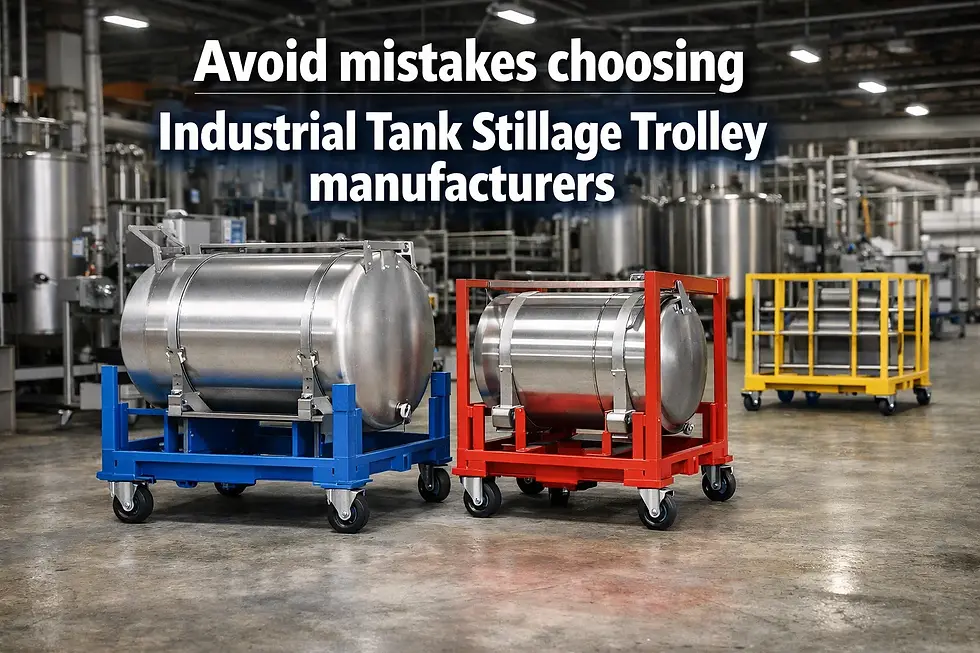
Selecting the right Industrial Tank Stillage Trolley manufacturers is not just a procurement task—it’s a safety and operational decision. For SMEs and industrial buyers, one wrong choice can lead to equipment failure, downtime, compliance issues, and unexpected expenses.
Yet many buyers repeat the same avoidable mistakes.
In fast-moving industrial environments, urgency often overrides due diligence. Budgets tighten. Timelines shrink. And decisions get made based on price or familiarity rather than structured evaluation.
If you want long-term reliability instead of short-term regret, understanding what not to do is just as important as knowing what to do.
Let’s break down the most common sourcing mistakes—and how to avoid them with confidence.
Mistake 1: Choosing Based on Price Alone
Price is important. But price without context is risky.
Lower pricing may result from:
Thinner steel frames
Lower-grade materials
Minimal load testing
Weak welding standards
Over time, this can cause:
Frame bending
Wheel failure
Frequent repairs
Premature replacement
Experienced procurement teams focus on total cost of ownership, not just purchase cost. A trolley that lasts 8–10 years is more valuable than one that needs replacement in 2.
Avoid short-term savings that create long-term losses.
Mistake 2: Skipping Load Testing Verification
One of the most overlooked areas in sourcing is load validation.
Buyers sometimes accept load ratings without documentation. But stated capacity and tested capacity are not always the same.
Always request:
Load testing reports
Engineering calculations
Safety factor margins
Professional Industrial equipment manufacturers typically provide structured documentation. If a supplier cannot explain how the load is distributed or validated, reconsider the decision.
Dynamic movement adds stress beyond static weight. Documentation matters.
Mistake 3: Ignoring Material and Welding Quality
Steel grade and weld integrity determine durability.
Weak weld joints are one of the most common failure points in industrial equipment. Poor-quality materials reduce fatigue resistance and corrosion protection.
Ask manufacturers:
What steel grade is used?
How thick is the structural frame?
What welding inspection process is followed?
An experienced Industrial equipment manufacturer Tamil Nadu with structured quality control systems will provide clear answers backed by process documentation.
Structural strength is not visible at first glance—but it defines lifespan.
Mistake 4: Overlooking Customization Needs
Every industrial facility is different.
Tank dimensions, movement frequency, floor surfaces, and environmental exposure vary widely. Yet many buyers assume standard models will work universally.
Failing to consider customization can lead to:
Instability during movement
Faster wear on wheels
Corrosion damage
Operational inefficiency
Confirm whether the manufacturer can adjust:
Frame dimensions
Wheel types
Reinforcement zones
Protective coatings
Customization improves both safety and performance.
Mistake 5: Not Evaluating Production Capability
Consistency matters—especially for repeat orders.
Some buyers skip evaluating the manufacturer’s infrastructure. Without structured production processes, quality may vary between batches.
Assess:
Production capacity
Lead time reliability
Quality checkpoints
Repeat order consistency
Reliable manufacturers operate with process discipline. This ensures stable quality across multiple purchases.
In industrial procurement, predictability builds trust.
Mistake 6: Ignoring Warranty and After-Sales Support
Equipment eventually experiences wear.
Buyers who fail to clarify warranty terms often struggle later with replacement disputes or unclear service processes.
Before confirming your order, ask:
What is covered under warranty?
How long is the warranty period?
What is the response time for defects?
Are spare parts readily available?
Clear documentation protects your investment.
After-sales support is not a bonus—it’s a necessity.
Mistake 7: Rushing Procurement Due to Urgency
Operational pressure sometimes forces quick decisions.
However, skipping verification steps can create larger problems later.
Even under tight deadlines, prioritize:
Technical documentation review
Load testing confirmation
Material specification validation
A few extra days of evaluation can prevent years of maintenance issues.
Mistake 8: Underestimating Environmental Impact
Industrial environments are demanding.
Moisture, chemicals, uneven flooring, and heavy usage accelerate wear.
Failure to account for operating conditions can shorten equipment lifespan significantly.
Ensure the manufacturer considers:
Corrosion-resistant coatings
Chemical-resistant wheel materials
Reinforced stress points
Operational alignment improves durability.
Mistake 9: Frequently Switching Suppliers
Some buyers chase marginal cost savings by switching suppliers often.
While competitive pricing is healthy, constant switching may lead to:
Inconsistent quality
Communication gaps
Lost relationship benefits
Long-term supplier partnerships often provide:
Better customization alignment
Predictable quality
Faster production cycles
Improved pricing stability
Stability reduces procurement friction.
Mistake 10: Failing to Define Internal Requirements
Sometimes the biggest mistake happens before contacting any supplier.
If internal needs are unclear, comparisons become inconsistent.
Before reaching out to manufacturers, document:
Maximum load weight
Tank dimensions
Floor conditions
Frequency of movement
Environmental exposure
Clarity improves sourcing outcomes.
Procurement confidence starts internally.
A Smarter Approach to Supplier Selection
To avoid these mistakes, follow a structured evaluation framework:
Define operational requirements clearly.
Request engineering documentation.
Verify load testing validation.
Assess material and welding standards.
Evaluate customization capability.
Review warranty and after-sales support.
Compare total lifecycle cost—not just price.
This disciplined approach reduces uncertainty and builds long-term operational stability.
Conclusion
Avoiding mistakes when choosing Industrial Tank Stillage Trolley manufacturers requires more than quick price comparison. It demands engineering awareness, documentation verification, and long-term thinking.
When buyers focus on structural integrity, customization flexibility, lifecycle value, and supplier accountability, they protect their operations from avoidable risk.
For those evaluating broader fabrication strength and production discipline, reviewing established Industrial equipment manufacturer Tamil Nadu can offer additional perspective during the shortlisting process.
Industrial infrastructure is foundational. Choose with clarity. Evaluate with discipline. Invest with confidence.
FAQs
1. What is the biggest mistake buyers make?
Focusing only on price instead of evaluating engineering quality and total lifecycle cost.
2. How important is load testing documentation?
It is critical. Documentation confirms that the trolley can safely handle specified loads.
3. Should customization always be considered?
Yes, especially if tank dimensions or environmental conditions differ from standard assumptions.
4. Why does material grade matter?
Higher-grade materials improve durability, corrosion resistance, and overall lifespan.


Comments