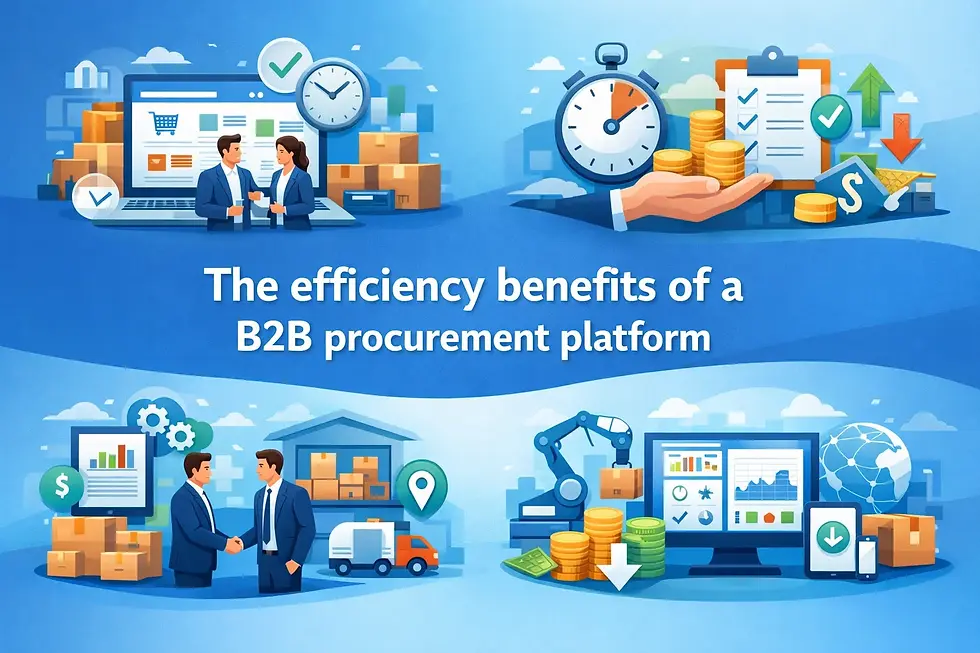
The efficiency benefits of a b2b procurement platform
- Aarav Reddy
- Feb 20
- 4 min read

For SMEs and exporters operating in competitive sectors like renewable energy and industrial manufacturing, these small inefficiencies compound quickly.
That’s why more businesses are adopting a structured b2b procurement platform.
This isn’t about replacing human relationships.
It’s about eliminating friction.
When procurement becomes efficient, companies reduce risk, protect margins, and scale with confidence. Let’s examine the specific efficiency gains that structured procurement systems deliver.
Centralized Information Reduces Administrative Chaos
One of the most immediate benefits of a procurement platform is information consolidation.
Without a system, procurement teams often manage:
• Multiple email conversations• Scattered product specifications• Separate folders for certifications• Disconnected approval workflows
This fragmentation slows decision-making.
A digital platform centralizes:
• Supplier profiles• Compliance documents• RFQs and quotations• Communication history
Centralization reduces time spent searching for information.
Less time searching means more time making decisions.
Efficiency begins with visibility.
Faster RFQ and Quotation Cycles
Traditional RFQ processes can be slow and inconsistent.
Procurement teams send individual emails, track responses manually, and reconcile information across different formats.
A structured system standardizes RFQ distribution and response collection.
This allows buyers to:
• Send requests to multiple suppliers simultaneously• Compare responses side-by-side• Track deadlines clearly
Shorter RFQ cycles improve project timelines.
In industries like renewable energy—where installation schedules are tight—faster sourcing directly impacts revenue realization.
Speed, when controlled and structured, becomes a competitive advantage.
Improved Supplier Comparison
Evaluating suppliers manually can create inconsistencies.
Different file formats.Incomplete documentation.Unclear specifications.
A b2b procurement platform standardizes evaluation criteria.
Buyers can compare:
• Pricing• Minimum order quantities• Certifications• Delivery timelines• Response speed
Side-by-side visibility reduces subjective bias.
Objective comparison strengthens procurement decisions.
Stronger decisions reduce future disputes and quality issues.
Reduced Communication Errors
Miscommunication is one of the most costly inefficiencies in procurement.
Incorrect specifications.Unclear delivery expectations.Outdated certification files.
Structured communication channels reduce these risks.
When all discussions are documented within a system:
• Clarifications are traceable• Updates are recorded• Agreements are visible
This minimizes misunderstandings.
Clarity reduces rework.Reduced rework saves time and money.
Streamlined Approval Workflows
As SMEs grow, internal approval chains become more complex.
Manual approval processes can delay purchasing decisions significantly.
Digital procurement systems automate approval routing.
For example:
• Requests move automatically to designated managers• Budget thresholds trigger review notifications• Status updates are visible in real time
This eliminates bottlenecks caused by overlooked emails or unclear responsibilities.
Automation enhances discipline.
Discipline enhances efficiency.
Better Supplier Performance Tracking
Efficiency is not just about speed—it’s about consistency.
A structured procurement system allows companies to monitor:
• On-time delivery rates• Quality compliance• Response times• Order accuracy
Over time, this data reveals patterns.
Procurement teams can identify:
• High-performing suppliers• Frequent delays• Recurring documentation issues
Data-driven insights support continuous improvement.
Continuous improvement protects margins.
Reduced Risk of Duplicate Orders
Manual systems often create order duplication risks.
Multiple team members may place similar orders unknowingly.Old spreadsheets may not reflect updated quantities.
A centralized b2b procurement platform tracks orders in real time.
Clear visibility prevents duplication.
Preventing duplicate purchases protects working capital and inventory efficiency.
For SMEs operating with tight budgets, this control is crucial.
Enhanced Budget Control and Forecasting
Procurement affects cash flow.
Without structured tracking, spending patterns can become unclear.
Digital systems provide analytics on:
• Purchase volumes• Supplier pricing trends• Seasonal demand shifts• Budget utilization
These insights improve forecasting accuracy.
Accurate forecasting supports:
• Inventory planning• Production scheduling• Financial stability
Financial efficiency strengthens operational resilience.
Supporting Scalable Growth
Growth increases procurement complexity.
More suppliers.More regions.More compliance requirements.More documentation.
Manual systems struggle under scaling pressure.
A structured platform absorbs complexity more effectively.
When workflows, documentation, and communication are standardized, scaling becomes manageable.
Scalability is one of the most strategic efficiency gains SMEs can achieve.
Strengthening Supply Chain Resilience
Recent global disruptions revealed vulnerabilities in supply chains.
Companies dependent on single suppliers experienced delays and cost spikes.
A structured procurement environment makes diversification easier.
Businesses can:
• Identify alternative suppliers quickly• Compare regional sourcing options• Maintain backup documentation
Resilience is efficient.
Preparedness reduces crisis-driven decision-making.
Efficient resilience prevents revenue loss.
Professionalizing Procurement Operations
Efficiency also influences perception.
Suppliers prefer working with organized buyers.Financial institutions value documented procurement processes.Investors appreciate operational discipline.
Structured procurement signals maturity.
Within a broader business ecosystem, professionalism strengthens credibility.
Credibility attracts stronger partnerships.
Renewable Energy Example: Efficiency in Action
Consider a renewable energy SME sourcing:
• Solar modules• Inverters• Mounting systems• Battery storage components
Each component requires certification verification and timeline coordination.
Without structured procurement, delays cascade.
A digital platform centralizes specifications and documentation, enabling synchronized purchasing.
Synchronization prevents costly installation delays.
In fast-moving sectors, procurement precision directly affects profitability.
Practical Steps to Maximize Efficiency
To extract full efficiency value, SMEs should:
1. Standardize Documentation Requirements
Ensure every supplier provides consistent certification formats.
2. Define Clear Evaluation Metrics
Use measurable criteria rather than subjective judgment.
3. Monitor Supplier Performance Regularly
Identify patterns early and address weaknesses proactively.
4. Train Teams on System Use
Efficiency depends on disciplined adoption.
5. Review Procurement Data Quarterly
Continuous analysis drives ongoing improvement.
Small operational adjustments create measurable efficiency gains.

Conclusion
The efficiency benefits of a structured b2b procurement platform extend far beyond convenience.
They include:
• Faster RFQ cycles• Centralized documentation• Reduced communication errors• Streamlined approvals• Better supplier comparison• Improved budget control• Enhanced scalability• Stronger resilience
For SMEs and exporters navigating complex global supply chains, procurement efficiency is not optional.
It is foundational.
When purchasing processes become structured and data-driven, businesses protect margins, reduce risk, and position themselves for sustainable growth.
Efficiency is not about speed alone.
It is about clarity, control, and consistency.
And in modern B2B trade, that makes all the difference.
FAQs
1. What makes a procurement platform more efficient than manual systems?
Centralized documentation, automated workflows, and structured supplier comparison reduce time and errors.
2. Can SMEs benefit as much as large enterprises?
Yes. Structured systems level the playing field by improving organization and control.
3. Does efficiency reduce flexibility?
No. It enhances flexibility by providing visibility and faster decision-making.
4. How does efficiency impact profitability?
Reduced errors, faster sourcing, and better forecasting directly protect margins.


Comments